
Specialist lender OSB Group posted a resilient first half and a bigger dividend, yet the market's focus on trimmed margin guidance has left the stock looking unduly cheap.
OSB Group (LSE: OSB) has delivered a steady set of first-half results, but investors have zeroed in on downgraded margin guidance rather than the specialist lender's rising dividend and resilient loan book, leaving the shares trading on just 7 times forward earnings with a 6.8% yield.
The sell-off followed management's decision to cut full-year net interest margin guidance to 215–220 basis points, down from around 225bps previously, after fierce competition for retail deposits pushed funding costs higher. That squeeze dragged first-half NIM down to 223 basis points from 230 a year earlier, and return on tangible equity guidance for the full year was trimmed to roughly 12.5%.
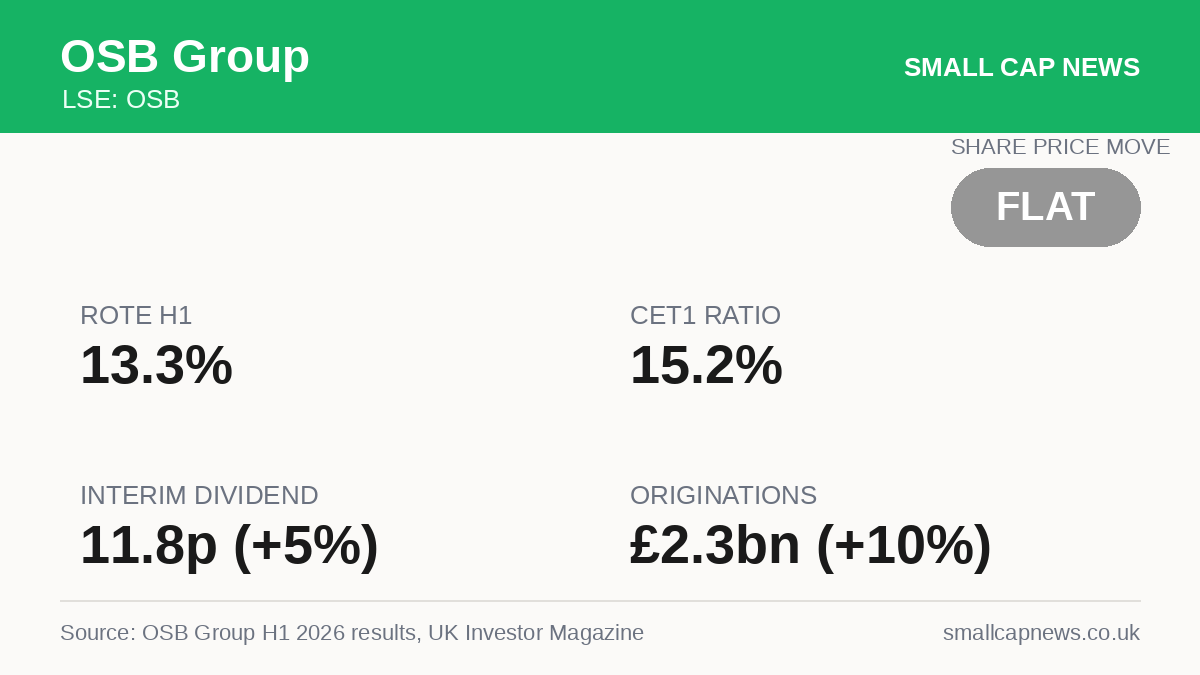
The underlying business, however, continues to perform well. Return on tangible equity came in at 13.3% for the six months to 30 June 2026, only slightly below last year's 13.7%, while the CET1 capital ratio stood at a comfortable 15.2%, well above the group's 13-13.5% target under incoming Basel 3.1 rules. Total originations rose 10% to £2.3bn, with Buy-to-Let lending up 23% and Precise-branded residential lending through CCFS surging 81%.
OSB, which lends through brands including Rely, InterBay and Precise and funds itself via the Kent Reliance and Charter Savings Bank deposit franchises, remains the UK's largest independent Buy-to-Let lender with a 4.3% share of gross new lending in 2025. Credit quality stayed solid, with a weighted-average loan-to-value ratio of 67% and arrears three months or more overdue easing to 1.6% from 1.7% at the year-end. Retail deposits grew 3% to £25.0bn, with retention rates of 95% at Kent Reliance and 90% at Charter Savings Bank.
The interim dividend was raised 5% to 11.8p in line with policy, and the group is midway through a second £100m buyback, having already repurchased close to £70m of stock, part of more than £1.3bn returned to shareholders since 2019. The key question for investors now is whether margin pressure from the competitive savings market persists into 2027, but with capital, credit quality and originations all holding firm, the case for a re-rating looks intact.
This report is based on OSB Group’s announcement and coverage by UK Investor Magazine. Company announcements can be tracked via London Stock Exchange RNS and Investegate, and the full markets calendar is worth watching for the next update.
This article is for general information only and does not constitute investment advice or a recommendation to buy or sell any security. Photo: Andre Taissin on Unsplash.

Small Cap News covers London’s junior market – AIM, small-cap and growth companies – with concise, sourced reporting on the results, deals and regulatory news that move share prices. We track the stories private investors actually need, from contract wins and drilling updates to fundraises and half-year figures, straight from the market’s own announcements.