
A year on from a landmark dividend rebase, Dunedin Income Growth (LSE: DIG) offers one of the fattest yields in UK equity income, even as its quality-tilted portfolio trails a narrow, cyclical market.
Dunedin Income Growth Investment Trust (LSE: DIG) has marked the first anniversary of a dividend overhaul that lifted its total payout by 34.5% to 19.10p per share, equivalent to a yield of roughly 6.1% at the current 314p share price, comfortably ahead of cash, the FTSE All-Share and most rivals in the UK Equity Income sector.
The board rebased the distribution to 6.0% of net asset value as at the previous July, extending a run in which the trust, managed by Aberdeen's Ben Ritchie and Rebecca Maclean, has raised its dividend in 42 of the past 46 years and every year since 2011. But dividend cover slipped to just 0.71 for the year, meaning the enhanced payout is being topped up from capital and reserves rather than income alone, a deliberate use of the closed-ended structure that the board says is backed by strong distributable reserves.
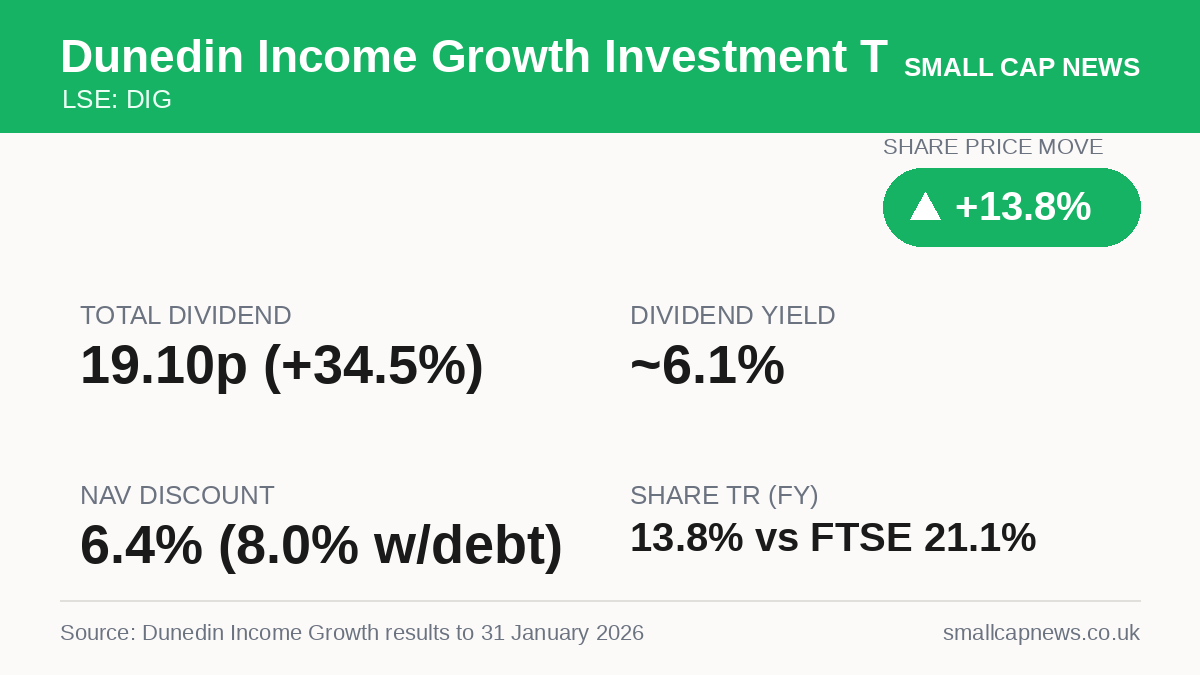
Performance told a more mixed story. NAV total return came in at 8.2% and share price total return at 13.8% for the year to January 2026, solid in isolation but well short of the FTSE All-Share's 21.1% gain, while the MSCI UK Quality Index it more closely resembles rose just 5.1% over the same period. A similar pattern showed up in the year to July 2026, with the shares returning 12.6% against 21.6% for the index. Managers point to a narrow, cyclical rally led by banks, aerospace and defence, and basic materials, sectors in which Dunedin is deliberately underweight, plus AI-related jitters that hit technology and information-services names such as RELX despite what they describe as robust underlying trading.
The trust runs a concentrated, high-conviction book of 37 holdings with a 75.5% active share, meaning it looks little like its benchmark. Financials are the largest exposure at 25.7%, led by Standard Chartered and NatWest, followed by industrials and technology at 15.6% and 15.5% respectively, with TotalEnergies the single largest position at 6.1%. Around 40% of the portfolio sits in companies capitalised below £10 billion, a mid-cap tilt the managers view as mispriced after years of large-cap dominance and increasingly attractive to private equity and strategic buyers.
The shares trade at a discount to NAV of around 6.4%, or 8.0% once debt is marked to fair value, narrowed from a double-digit gap a year ago but still leaving room to close further. Managers frame this as a 'triple discount' spanning the share price, the portfolio's rating against a cheap UK market, and the UK market's own rating against history and global peers. Income investors will want to watch dividend cover rebuild from its current low base, while the wider question for holders is whether a quality-focused, lower-beta portfolio can close the performance gap once market leadership broadens beyond banks, miners and defence stocks.
This report is based on Dunedin Income Growth Investment Trust’s announcement and coverage by UK Investor Magazine. Company announcements can be tracked via London Stock Exchange RNS and Investegate, and the full results calendar is worth watching for the next update.
This article is for general information only and does not constitute investment advice or a recommendation to buy or sell any security. Photo: Sean Pollock on Unsplash.

Small Cap News covers London’s junior market – AIM, small-cap and growth companies – with concise, sourced reporting on the results, deals and regulatory news that move share prices. We track the stories private investors actually need, from contract wins and drilling updates to fundraises and half-year figures, straight from the market’s own announcements.