
A billion-barrel prize is only as good as the permit that lets you drill for it — and in Greenland, that permit is taking longer than the market hoped.
80 Mile (AIM: 80M), the exploration company chasing oil and titanium in Greenland, saw its shares fall around 24% to 0.48p after it pushed back the timetable for drilling its flagship Jameson Land Basin project. The company had been targeting the 2026/27 winter season, but said current guidance from Greenlandic regulators now points to winter 2027, as permitting and regulatory approvals take longer to complete than expected.
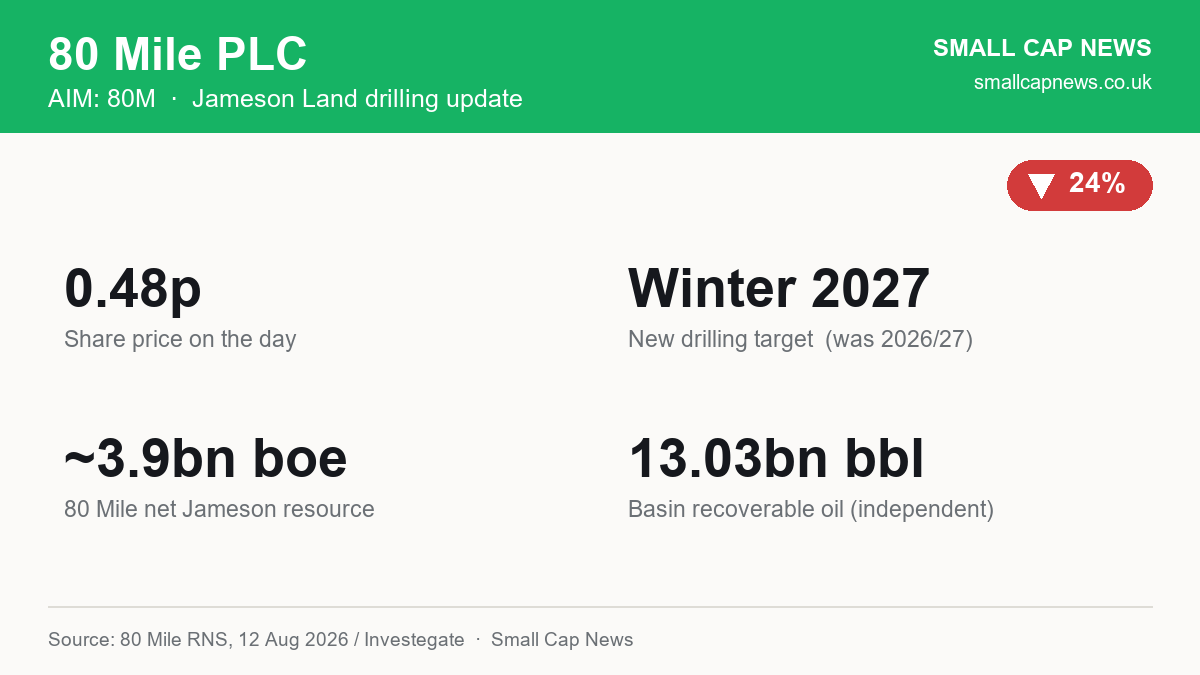
The scale of what is at stake explains why the delay stung. An independent assessment has put the Jameson Land Basin’s recoverable oil at 13.03 billion barrels, of which 80 Mile holds roughly 3.9 billion barrels equivalent net — an enormous notional resource for a company whose entire market value is measured in single-digit millions of pounds. For a pre-revenue explorer with no production and negative cash flow, however, the gap between an in-the-ground estimate and a drill bit in the rock is exactly where the risk lives, and every season of delay pushes back the moment that potential can be tested.
The update carried a second, more awkward disclosure. 80 Mile confirmed it had received a formal warning from the Greenland government over equipment tied to its Dundas titanium and ilmenite project, which was landed and stored near Nerlerit Inaat airport without the required mining-regulator permit. The company said it had a storage arrangement with state-owned Greenland Airports A/S but acknowledged the separate regulatory permit had not been in place, and committed to strengthening its logistics and compliance procedures. Coming at the same time as the drilling delay, the episode fed a wider question about how smoothly the company is navigating Greenland’s tightening regulatory regime.
80 Mile was at pains to stress that the postponement does not change its commitment to the project, saying its broader plans for Jameson remain unchanged and that drilling will proceed once the necessary approvals are secured. The company argues the resource, and the strategic interest in Greenland’s hydrocarbons and critical minerals, are unaffected by a timing shift.
For investors, the read-across is about funding and patience. A company with no revenue and a reliance on continued access to capital now has a longer wait before its headline asset can be de-risked by the drill — and a fresh reminder that permitting risk in a sensitive Arctic jurisdiction is as material as anything found in the geology. The next catalysts will be procedural rather than operational: evidence that the permitting process is advancing, and that the regulatory warning has been resolved cleanly.
This report is based on 80 Mile’s regulatory news of 12 August 2026 and coverage by AJ Bell / ADVFN and Share Talk. The original announcement and further filings can be tracked via London Stock Exchange RNS and Investegate, alongside our wider small-cap company coverage.
This article is for general information only and does not constitute investment advice or a recommendation to buy or sell any security. Photo: Alex Rose on Unsplash.

Small Cap News covers London’s junior market – AIM, small-cap and growth companies – with concise, sourced reporting on the results, deals and regulatory news that move share prices. We track the stories private investors actually need, from contract wins and drilling updates to fundraises and half-year figures, straight from the market’s own announcements.